
3D Scanning for Historic Preservation & Architectural Restoration
Schimmel Engineering uses a Creaform HandyScan Black Elite metrology-grade scanner — accurate to ±0.0009 in. — to document, archive, and reproduce the ornamental details that define Nashville's historic neighborhoods. From crown molding to porch column capitals, we capture what matters before it's lost.
When History Crumbles, You Can't Buy a Replacement at a Big-Box Store.
Nashville's historic neighborhoods — from the Greek Revival porches of Germantown to the Italianate storefronts of Belmont-Hillsboro and the Victorian manors of East Nashville — are defined by details that no longer exist in any catalog. When water damage, age, or accident destroys an original ornamental element, the only path to an authentic restoration is to measure what remains and reproduce it exactly.
The Problem with "Close Enough"
Traditional restoration often relies on hand-carving or off-the-shelf profiles that approximate the original. The result is a replacement that looks obviously new next to a century of weathered wood, plaster, or stone — undermining the character of the home and risking non-compliance with Historic Zoning Overlay and National Register of Historic Places standards.
3D laser scanning changes the equation entirely. By capturing the exact geometry of a surviving original — including the softened edges, surface texture, and dimensional variation that define period craftsmanship — we produce a digital master that makes reproductions indistinguishable from originals.
We've used this workflow to restore column capitals on a Lockeland Springs porch so faithfully that they were indistinguishable from 110-year-old originals standing five feet away.
How Does the Digital-to-Analog Preservation Workflow Work?
Every historic preservation scanning project at Schimmel Engineering follows a proven process that bridges 21st-century metrology with period-correct craftsmanship.
On-Site Laser Scanning
We bring our Creaform HandyScan Black Elite to your property — no scaffolding, no surface preparation, no contact with fragile historic surfaces. The scanner captures a high-density point cloud at 1.8 million points per second. Most single-element scans take 15–60 minutes.
Digital Cleanup & Refinement
Raw scan data is processed in VXElements and VXModel to remove dust, paint layers, and surface noise — revealing the original design intent. We extract precise profiles, cross-sections, and surface meshes, preserving authentic weathering where it matters.
CAD Engineering
Cleaned scan data is engineered in SolidWorks into production-ready geometry. For molding reproduction, we generate DXF profiles for laser cutting. For sculptural elements, we build segmented assemblies with engineered fastening systems.
Manufacturing & Fabrication
We coordinate precision laser cutting of aluminum dies for plaster running, FDM, MJF, or SLS additive manufacturing for sculptural reproductions, or CNC machining for metal and wood components.
Digital Archive Delivery
Every project concludes with a complete digital archive: scan data, CAD models, DXF profiles, and documentation photographs. Deliverables include STL, STEP, OBJ, DXF, and PDF drawing packages — so replacement is always on file.
Installation Support
We provide engineering support for installation, including fit verification, fastener design, and coordination with plaster artisans, millworkers, or general contractors. Parametric assembly designs mean no field modification is required.
What Can 3D Scanning Do for Historic Preservation?
Schimmel Engineering has completed preservation scanning projects across Middle Tennessee for homeowners, architects, preservation contractors, and institutions.
Ornamental Plaster Crown Molding
Scan surviving sections, extract the true profile, engineer a laser-cut aluminum die, and coordinate with local plaster artisans to run new lengths that are exact matches — including the subtle dimensional variation of period-cast work. Ideal for National Register and historic tax credit projects.
Porch Column Capitals & Millwork
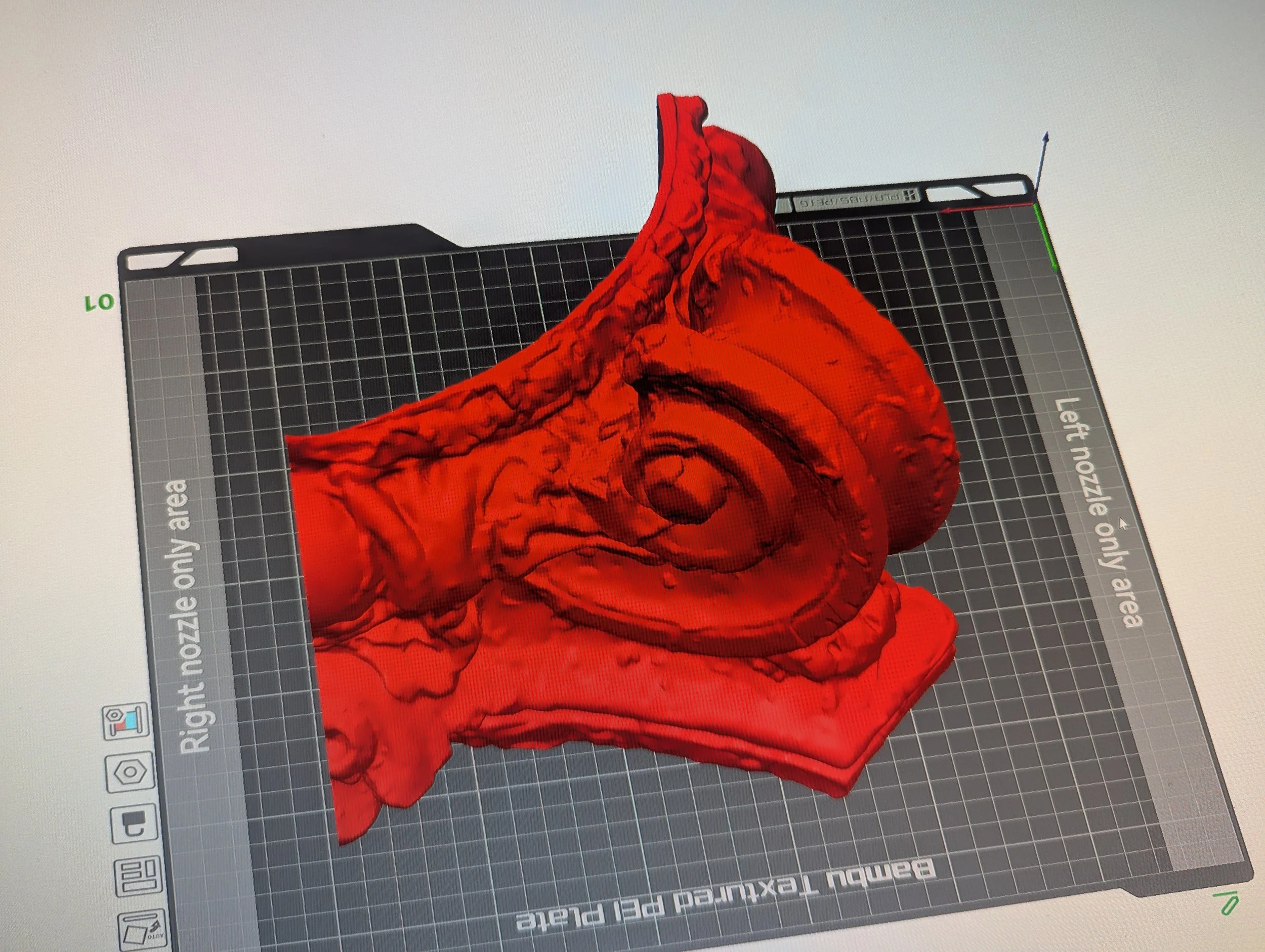
Scan an original ornamental capital, segment the model for large-format 3D printing in durable ABS, and produce reproductions that replicate a century of weathering. Results are indistinguishable from originals at five feet — and won't rot, warp, or attract termites.
As-Built Documentation
Generate precise as-built drawings and 3D models of existing conditions for renovation permits, insurance documentation, historic district compliance, or estate records. Covers floor plans, elevations, ornamental details, and structural elements — all non-contact.
Sculptural Archiving & Bronze Casting Prep
Capture high-resolution scan data of sculpture, memorial markers, or decorative stonework for digital archiving, scale modification, or foundry reproduction. We've taken projects from point cloud to bronze cast in coordination with local foundries.
Decorative Tile, Stone & Masonry
Document period tile patterns, stone carving profiles, masonry joint dimensions, and surface textures for reproduction, repair matching, or historic survey records. Outputs include surface meshes, profile drawings, and photographic overlays.
Historic Tax Credit & Zoning Compliance
Produce the precise existing-conditions documentation required by the Tennessee Historical Commission, the National Park Service, and Metro Nashville Historic Zoning Overlay applications. Deliverables meet federal documentation standards for Section 106 review.
Historic Preservation Work in Nashville & Middle Tennessee
Real projects — not renderings or hypotheticals.
Column Restoration · East Nashville
How 3D Scanning Replicated a Century of Weathering on a Lockeland Springs Porch
Five missing ornamental column capitals. One original left to scan. Reproductions indistinguishable from 110-year-old originals — including the weathering.
Read the Case Study →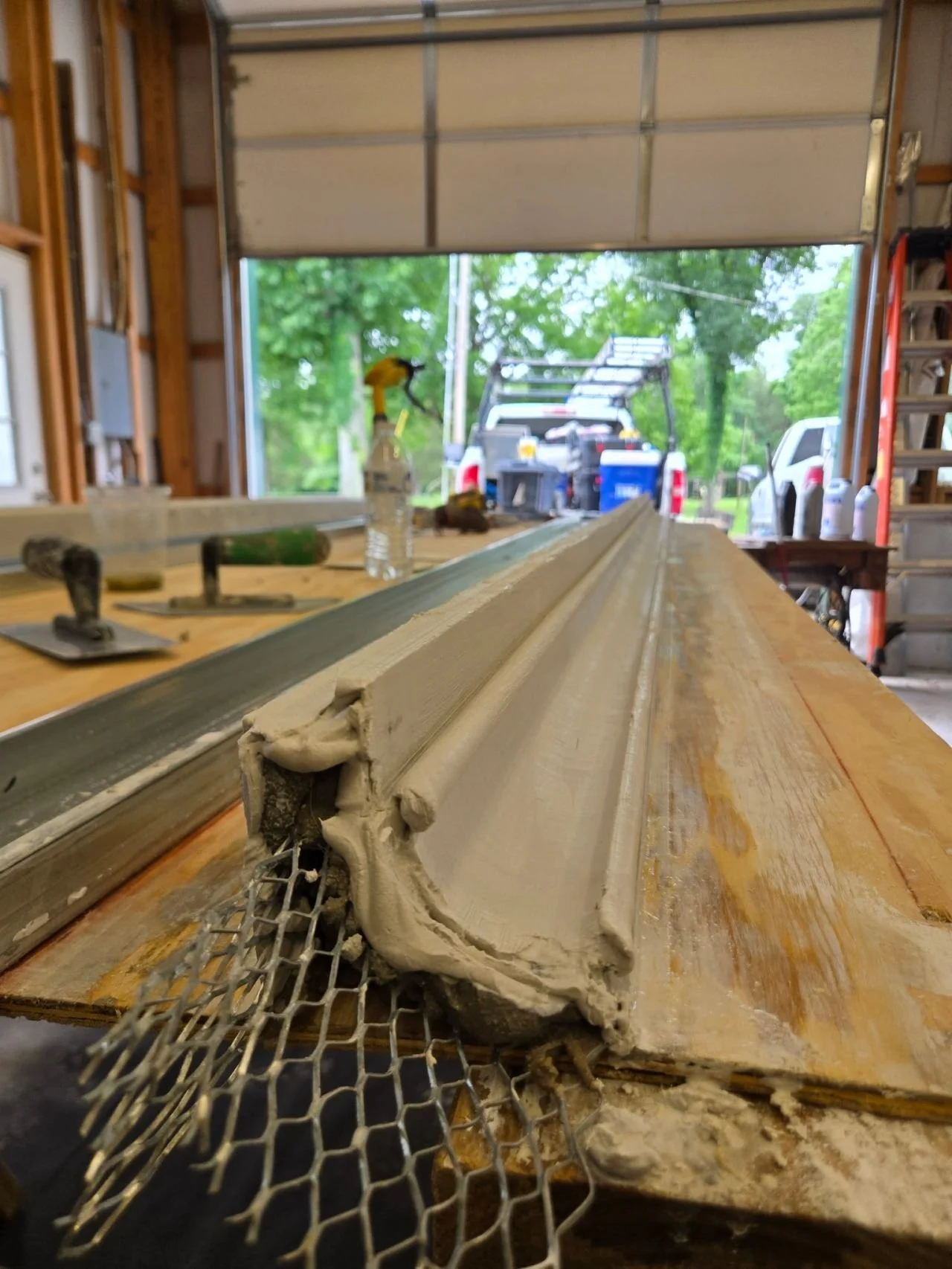
Crown Molding · Hermitage, TN
Reviving Nashville's Grandeur: 3D Scanning Saves Ornamental Plaster Molding
Water-damaged plaster on a National Register property. Scanned, engineered a laser-cut aluminum die, coordinated local artisans to run exact reproductions.
Read the Case Study →
Sculptural Archiving · Green Hills, Nashville
Sculptural Scan, Enlarge & Bronze Cast for a Green Hills Artist
High-resolution scanning of an original sculpture for digital archiving and foundry enlargement. Scan-to-watertight-mesh in STL/OBJ format from $470.
Read the Case Study →3D Scanning for Historic Preservation — Frequently Asked Questions
How accurate is 3D scanning for historic preservation work?
The Creaform HandyScan Black Elite achieves ±0.025mm (0.0009 inch) volumetric accuracy — far exceeding what any traditional physical templating method can produce. This precision captures not only the designed profile of an ornamental element but the authentic wear and hand-work variation that give historic details their character. For reference, a human hair is roughly 0.07mm wide.
Can 3D scanning help with Tennessee historic tax credit projects?
Yes. Precise as-built documentation supports both the Federal Historic Tax Credit (20% credit for certified rehabilitations) and the Tennessee Historical Commission state program. Our deliverables — dimensioned drawings, 3D models, and photographic documentation — help demonstrate compliance with the Secretary of the Interior's Standards for Rehabilitation.
Does the scanning process damage fragile historic surfaces?
No. The Creaform HandyScan is entirely non-contact — it emits structured blue light that reflects off surfaces without touching them. There is no chemical spray, no physical templating, and no risk to plaster, paint, gilding, or delicate wood. The process generates no heat and requires no surface preparation in most preservation applications.
What does a historic preservation scanning project cost?
Scanning starts at $130/hr for single-element capture. A complete ornamental reproduction project — scan, digital cleanup, CAD model, and die or print file delivery — typically runs $470 to $1,500 depending on element complexity. As-built documentation for an entire room or facade is quoted per project. Send us photos and we'll give you a fast estimate.
What neighborhoods and areas in Nashville do you serve?
We serve all of Middle Tennessee including East Nashville (Lockeland Springs, Edgefield, Eastwood), Germantown, Belmont-Hillsboro, Belle Meade, Hermitage, Franklin, Brentwood, and Murfreesboro. For small elements, we offer mail-in scanning — ship the part to our Nashville lab and we'll return it with a complete digital file package.
Ready to Preserve Your Piece of Nashville?
Send us photos. We'll tell you exactly what scanning can do for your project — and what it'll cost.