

Themed Entertainment & Animatronics
Mechanical engineering is the backbone of every figure that moves, every exhibit that reacts, and every environment that immerses. Schimmel Engineering brings professional engineering discipline to themed entertainment — from actuator sizing and SolidWorks motion analysis through PLC show programming and global field support. We've seen projects from the first sketch to the thousandth show.
Engineering That Brings Characters to Life.
Themed entertainment demands something most engineering disciplines don't: the ability to work fluently across structural steel, precision motion control, sculptural organic geometry, and creative direction — simultaneously, under budget, and on a deadline. Schimmel Engineering has operated at that intersection across multiple continents and multiple figures.
Our experience spans the full lifecycle — from the first approximation in SolidWorks Motion Analysis to tuning a PID loop on a live touring figure, to writing the service documentation that keeps it running five years after installation. We don't just design figures. We've programmed them, installed them, supported them in the field, and watched them fail so we could understand why.
That breadth of experience — mechanical designer, show programmer, field engineer, and creative collaborator — is what we bring to every themed entertainment project.

How Does a Figure Go From Concept to Performance?
Every animatronic project follows an engineering workflow that balances creative intent, structural reality, motion performance, and long-term serviceability.
Creative Intake & Scope
We start by understanding the creative vision — working directly with art directors, sculptors, and animators to extract the motion requirements that will drive mechanical decisions. Animation files from Maya or similar tools inform early motion analysis and help establish realistic expectations around axis count, range of motion, and speed.
Actuator Sizing & Selection
Using SolidWorks Motion Analysis, we approximate subassembly weights and model motion profiles to size actuators within manufacturer guidance — targeting 1,000,000+ cycle life. We consider gravity loading, duty cycle, winding heat soak, and creative intent simultaneously. Pneumatic air springs are added to gravity-affected axes to offload static holding from electric actuators, reserving their capacity for dynamic motion.
Structural & Mechanism Design
All mechanical design takes place in SolidWorks. Structural steel profiles are coordinated with sculptural organic elements — a discipline that requires close collaboration with industrial designers and sculptors. Weldment drawings go to local and global fabricators. Machine part drawings are detailed for domestic and overseas production.
Figure Finish Integration
Mechanical doesn't stop at the armature. We design and detail the integration points for skin, fur, fiberglass, and 3D printed shell components — coordinating access hatches, serviceable attachment points, and skin clearances with the sculptural team. 3D printing for shells where possible reduces mold costs and makes figures repeatable.
Show Programming & PID Tuning
With experience on Beckhoff PLC systems and SMPTE timecode show triggering, we program and tune each motion function independently — achieving compliance through quadrature incremental encoders and piezoelectric force gauges. Compliance provides active damping, enabling high-speed motion with smooth acceleration profiles and no structural wobble or jerkiness.
Installation, Touring & Field Support
Figures designed for touring must survive teardown, shipping, and reinstallation — repeatedly. We design for that reality: hand-carry accessible components, labeled connectors, standardized fasteners, and comprehensive service documentation. We've supported field crews running simultaneous worldwide tours and witnessed firsthand what happens when figures are pushed beyond design intent.
What Can Schimmel Engineering Do for Your Themed Entertainment Project?
Our involvement adapts to your project's needs — from full-scope lead mechanical engineering to targeted consulting on a specific discipline.
Animatronic Figure Mechanism Design
Full mechanical design of animatronic figure armatures — from structural steel weldments to precision servo mounts, actuator clevises, and joint hardware. We produce complete SolidWorks models and manufacturing drawings for domestic and overseas fabrication, with fit checks against sculptural geometry.
Show Programming & Motion Control
PLC-based show programming with SMPTE timecode triggering, PID compliance tuning, and motion profile development. Each function tuned for smooth performance across the full range of show conditions — from initial deployment through the thousandth performance.
Actuator & Drive System Engineering
Actuator selection and sizing for electric linear actuators, harmonic drive strain wave gearboxes, brushless DC servo systems, and pneumatic air spring counterbalances. We size within manufacturer guidance for long cycle life and work back and forth with creative teams to balance performance and budget.
Shell & Figure Finish Design
Industrial design and engineering of 3D printed shells, access hatches, and skin integration structures. We coordinate mechanical attachment points with sculptors and skin fabricators, minimizing mold costs through strategic use of additive manufacturing while preserving the organic surface quality that makes figures believable up close.
Interactive Exhibit Engineering
Mechanical design for interactive exhibits requiring structural robustness, vibration isolation, and guest-proof construction. Our experience includes low-frequency transducer integration, urethane rubber vibration isolation, and fully serviceable/renewable design — for installations that run continuously in public-facing environments.
Touring & Portable Figure Design
Engineering for figures that must tour — designed to fit in standard shipping containers, run on available venue power (3-phase 480V), and support rapid teardown and reinstallation by field crews. We document everything for the people who weren't in the room when it was designed.

The Benchmark: A 35,000 lb, 17-Axis Touring Animatronic Figure.
The most complex project in our portfolio set the standard for what full-scope animatronic engineering looks like. Ryan Schimmel served as Lead Mechanical Engineer and Show Programmer from concept through global touring installation — a 4-year engagement that is still running today.
Themed Entertainment Projects from the Schimmel Engineering Portfolio
Each project below represents direct, hands-on engineering responsibility — not consulting from a distance.

Animatronic Figure · Lead Mechanical Engineer & Show Programmer
Electrically Actuated Animatronic Dinosaur — 35,000 lb / 17 Axes
Full-scope mechanical design and show programming on a globally touring animatronic figure. Electric linear actuators, harmonic drives, Beckhoff PLC, SMPTE timecode, SolidWorks Motion Analysis, and 4 years from concept to stage.
View Project →
Animatronic Figure · Mechanism & Shell Design · IAAPA 2024
Big Foot Bob — 8-Foot, 5-Axis Animatronic Sasquatch
Head mechanism and shell design for an 8-foot animatronic Sasquatch shown at IAAPA 2024. Hitec servos, lead screw linear actuators, 3D printed shells with cast silicone skins. Available to order from Axtell Expressions.
View Project →
Interactive Exhibit · Empire State Building
Empire State Building Ape Hands — Interactive Vibrating Exhibit
Mechanical design for guest-interactive animatronic hands installed in the Empire State Building. Low-frequency linear transducers, urethane rubber vibration isolation from structure, fully serviceable and renewable design for continuous public operation.
View Project →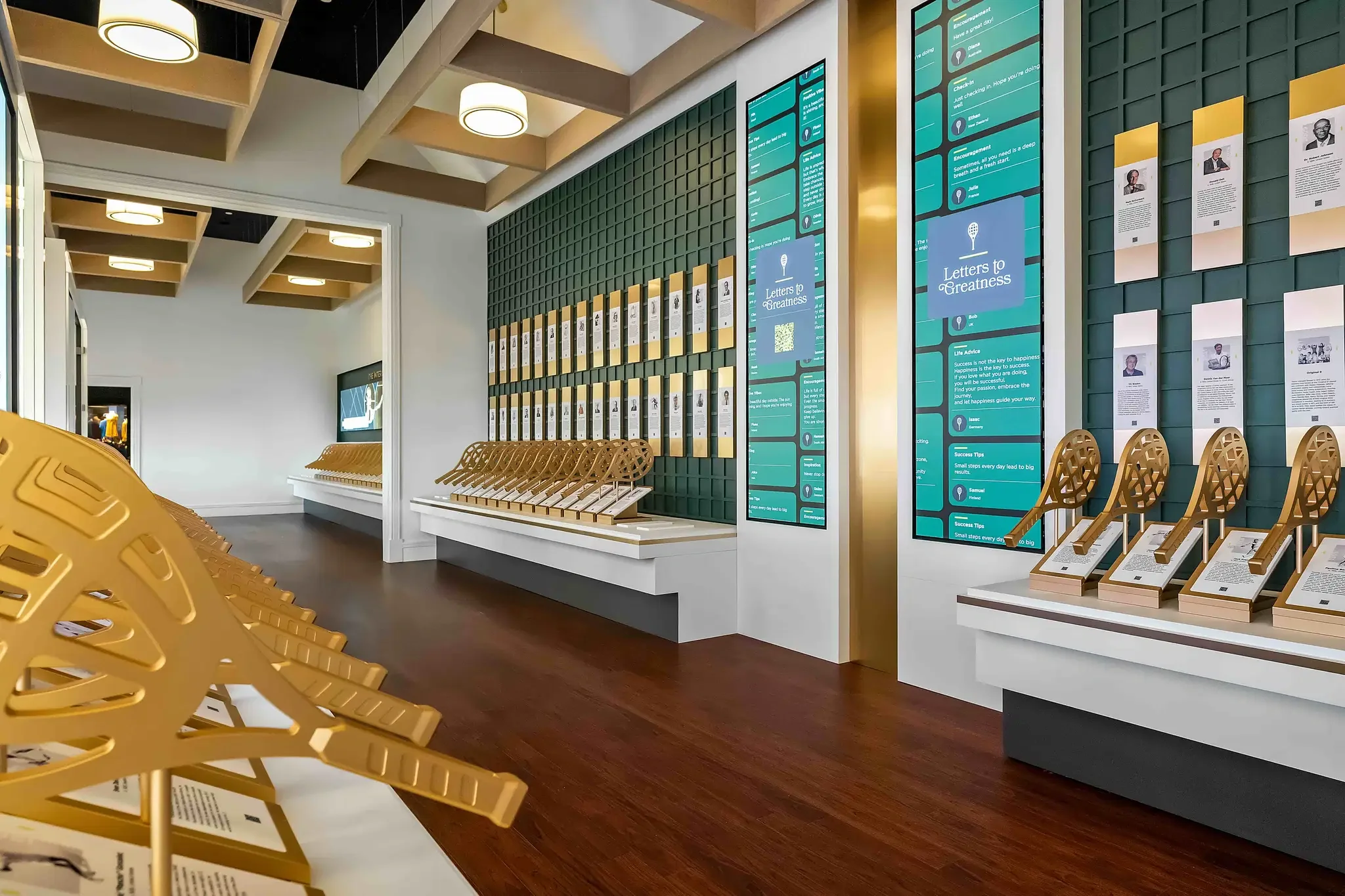
Themed Environment · Newport, Rhode Island
International Tennis Hall of Fame — Museum Renovation
Part of the collaborative team behind a multi-million dollar transformation of 13,000+ sq ft of gallery space in Newport, Rhode Island. Architectural element creation supporting immersive exhibit design for a world-class sports museum.
View Project →Themed Entertainment Engineering — Frequently Asked Questions
What animatronic engineering services does Schimmel Engineering offer?
Full-scope mechanical engineering for animatronic figures and themed environments — from concept and actuator sizing through SolidWorks modeling, manufacturing documentation, figure finish integration, and PLC show programming. We have hands-on experience with electric linear actuators, harmonic drives, servo systems, pneumatic air springs, and Beckhoff PLC show control with SMPTE timecode.
What is the largest animatronic project Schimmel Engineering has worked on?
A 35,000 lb, 17-axis electrically actuated animatronic figure for a globally touring exhibition. Ryan Schimmel served as Lead Mechanical Engineer and Show Programmer from concept through installation — a 4-year engagement that included actuator sizing, SolidWorks Motion Analysis, PID compliance tuning, and field support across multiple worldwide venues. It is still touring today.
Can Schimmel Engineering design figures for touring or mobile deployments?
Yes. The 35,000 lb figure was specifically engineered to tour — fitting inside a 40ft shipping container, running on 3-phase 480V venue power, and supporting teardown and reinstallation at multiple global venues. Portable, durable, and serviceable design is a core consideration from the start of any touring figure project.
What show control systems does Schimmel Engineering work with?
We have hands-on experience with Beckhoff PLC show control systems and SMPTE timecode show triggering on a PLC LAN network. Each motion function is individually PID-tuned for compliance — active damping via quadrature encoders and piezoelectric force gauges — enabling high-speed motions with smooth acceleration profiles and no visible structural wobble.
Does Schimmel Engineering work with sculptors, artists, and creative teams?
Yes — it's one of the most rewarding aspects of this work. We've collaborated directly with industrial designers, sculptors, animators, electricians, controls engineers, and art directors. Our experience integrating sculptural organic elements to structural steel profiles and coordinating with Maya-based riggers gives us genuine fluency in cross-discipline creative workflows. We understand how sculptors and animators think, and that understanding shapes how we design.
Why does themed entertainment and mechanical engineering go hand in hand?
Every figure that moves, every surface that reacts, every exhibit that guests interact with has a mechanical system underneath it. Getting that system right — sized correctly, tuned properly, designed to survive thousands of performances — is the difference between a figure that amazes and one that's constantly in for repair. Mechanical engineering done right is invisible. Done wrong, it's all anyone talks about.
Have a Figure That Needs to Move?
Tell us about your project — the creative vision, the scale, and the timeline. We'll tell you what the engineering path forward looks like.